Key Takeaways
✓ There is no single best ashwagandha supplement. The useful questions are which part of the plant, powder or extract, how much per serving, and how it is tested.
✓ Most clinical studies used standardized root extracts, not plain root powder. The two should not be treated as equivalent.
✓ Ashwagandha is not for everyone. Rare cases of liver injury have been reported, and it is not advised in pregnancy.
1. Which part of the plant
Ashwagandha is the plant Withania somnifera. Traditional use centres on the root. Some extracts also use the leaf, which is cheaper and higher in certain withanolides. A good label says which part is used. If it says only "ashwagandha", you cannot tell.
2. Root powder or extract
Root powder is the dried, milled root. It is the traditional form and the label amount is the weight of the root itself.
Extracts concentrate the root, or root and leaf, and are usually standardized to a percentage of withanolides, the compounds used as a quality marker. Several branded, standardized extracts exist, each with its own studies. An extract and a powder with the same milligram amount are not the same thing.
3. What the studies actually used
In an 8-week placebo-controlled trial, adults with elevated perceived stress taking 600mg/day of a standardized ashwagandha root extract had lower serum cortisol and better self-reported sleep quality than placebo. Research discussed here relates to individual ingredients and does not establish that the finished Veluna product has been clinically studied or will produce the same results (PMID: 32021735).
A 2021 meta-analysis pooled five randomized trials with 400 participants. It found a small but significant effect of ashwagandha extract on overall sleep, more pronounced in trials lasting eight weeks or longer, and noted that long-term safety data are limited (PMID: 34559859).
Both used extracts. If you buy root powder, you are buying the traditional form, not the material those trials tested.
4. Organic, and black pepper
Certified organic tells you how the plant was grown. It says nothing about strength.
Black pepper extract, or piperine, is often added to herbal products. The well-known human data are for curcumin, where piperine raised blood levels (PMID: 9619120). Comparable evidence for ashwagandha is lacking, so treat black pepper as a reasonable addition rather than a proven advantage.
5. Safety: who should not take it
The NIH describes ashwagandha as possibly safe for up to about three months, with little information on longer use. It advises against use during pregnancy and urges caution for people with thyroid conditions, autoimmune conditions, certain hormone-sensitive conditions, or upcoming surgery (NCCIH; NIH Office of Dietary Supplements).
Rare cases of liver injury have been linked to ashwagandha supplements. In a case series of five patients, symptoms appeared 2 to 12 weeks after starting, and liver tests returned to normal within one to five months in the four patients who were followed (PMID: 31991029). Stop and see a doctor if you notice yellowing of the skin or eyes, dark urine, or persistent itching.
A label checklist
- Plant part stated: root, leaf, or both.
- Powder or extract stated, with withanolide percentage if it is an extract.
- Amount per capsule and capsules per serving.
- Third-party testing, and a Certificate of Analysis available on request.
- No proprietary blend that hides the amount.
Where Veluna fits
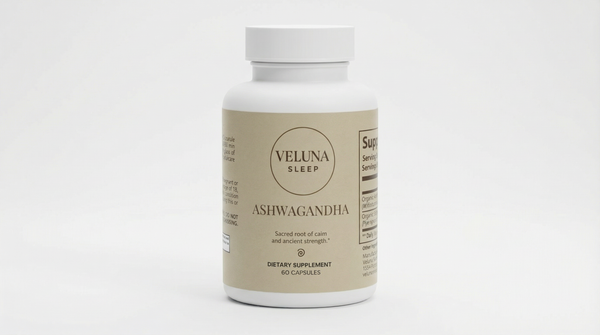
Veluna Ashwagandha is organic ashwagandha root, 650 mg per capsule, with 5 mg of organic black pepper, in a pullulan capsule. It is root powder, not a branded or standardized extract, and the label direction is one capsule twice a day. It is third-party tested. Ashwagandha supports a healthy stress response and helps maintain already-normal cortisol levels. It is one of our melatonin-free sleep supplements.
Common questions
What is the best form of ashwagandha?
It depends on what you want. If you want the material used in most trials, look for a standardized root extract and check the withanolide percentage. If you want the traditional whole-root form, choose an organic root powder with the amount stated.
Is a branded extract better than plain ashwagandha root?
A branded, standardized extract comes with its own studies. That makes it better documented, not automatically better for you. Veluna Ashwagandha is organic root powder, not a branded extract.
When should I take ashwagandha?
Follow the label. It is usually taken daily rather than only at bedtime. For other options without melatonin, see our melatonin-free sleep supplements.
How long can I take it?
Studies have mostly lasted up to about three months, and the NIH notes that little is known about longer use. It is sensible to review it with a healthcare professional rather than take it indefinitely.
References
- Salve J, Pate S, Debnath K, Langade D. Adaptogenic and anxiolytic effects of ashwagandha root extract in healthy adults: a double-blind, randomized, placebo-controlled clinical study. Cureus. 2019;11(12):e6466. PMID: 32021735
- Cheah KL, Norhayati MN, Husniati Yaacob L, Abdul Rahman R. Effect of ashwagandha (Withania somnifera) extract on sleep: a systematic review and meta-analysis. PLoS One. 2021;16(9):e0257843. PMID: 34559859
- Björnsson HK, Björnsson ES, Avula B, et al. Ashwagandha-induced liver injury: a case series from Iceland and the US Drug-Induced Liver Injury Network. Liver Int. 2020;40(4):825-829. PMID: 31991029
- Shoba G, Joy D, Joseph T, et al. Influence of piperine on the pharmacokinetics of curcumin in animals and human volunteers. Planta Med. 1998;64(4):353-356. PMID: 9619120
- National Center for Complementary and Integrative Health. Ashwagandha. nccih.nih.gov
- National Institutes of Health, Office of Dietary Supplements. Ashwagandha: Is It Helpful for Stress, Anxiety, or Sleep? Fact Sheet for Health Professionals. ods.od.nih.gov
*These statements have not been evaluated by the Food and Drug Administration. This product is not intended to diagnose, treat, cure, or prevent any disease. This article is for informational purposes only and does not constitute medical advice. Talk to a healthcare professional before starting any supplement, especially if you are pregnant, nursing, taking medication, or have a medical condition.