Key Takeaways
✓ No form of magnesium has been shown to be the best for sleep. The studies that exist are small, and they used different forms.
✓ Glycinate is the form most people choose for the evening. Citrate dissolves well but larger amounts can loosen stools. Oxide packs the most magnesium per capsule, but less of it is absorbed.
✓ Compare elemental magnesium per serving and stay under 350 mg a day from supplements.
What the sleep research actually shows
A systematic review pooled three randomized trials in 151 older adults with trouble sleeping. People taking magnesium fell asleep about 17 minutes faster than those on placebo. Total sleep time improved by about 16 minutes, which was not statistically significant, and the authors rated the evidence as low to very low quality (PMID: 33865376).
A 2025 placebo-controlled trial gave 155 adults who reported poor sleep 250 mg of elemental magnesium a day as bisglycinate. After four weeks, scores on a standard sleep questionnaire improved modestly more with magnesium than with placebo. The authors call the effect small (PMID: 40918053).
Research discussed here relates to individual ingredients and does not establish that the finished Veluna product has been clinically studied or will produce the same results.
So the fair summary is this: magnesium is a reasonable thing to try as part of an evening routine, the expected effect is modest, and nobody has shown that one form beats another for sleep.
The forms, compared
| Form | What it is | Worth knowing |
|---|---|---|
| Glycinate (bisglycinate) | Magnesium bound to the amino acid glycine (chelated) | The usual evening choice. Bulky, so a serving is often several capsules. |
| Citrate | Magnesium bound to citric acid | Dissolves well. Larger amounts can have a laxative effect. |
| Oxide | Magnesium bound to oxygen | Most magnesium by weight, but absorbed less completely than forms that dissolve well. |
| L-threonate | Magnesium bound to threonic acid | Low elemental magnesium per capsule and a higher price. |
A systematic review of 14 studies found that organic forms such as glycinate and citrate appear to be more bioavailable than inorganic forms such as oxide, that the percentage absorbed falls as the dose rises, and that all forms can maintain normal levels in healthy people (PMID: 34111673).
How to choose
- Pick a form your stomach tolerates. The NIH notes that carbonate, chloride, gluconate and oxide are the forms most often reported to cause diarrhea.
- Read the elemental amount. A label may show a large compound weight and a much smaller magnesium figure. Compare the magnesium figure.
- Check for "buffered". It means a chelate blended with magnesium oxide.
- Mind the limit. The NIH upper limit for magnesium from supplements is 350 mg a day for adults. Magnesium in food does not count toward it (NIH Office of Dietary Supplements).
- Take it consistently. A consistent evening wind-down, with the same cues in the same order every night, is one of the best-supported things you can do for sleep.
If you are pregnant, nursing, have kidney disease or take prescription medication, talk to a healthcare professional first. Magnesium can interfere with how some medicines are absorbed.
Where Veluna fits
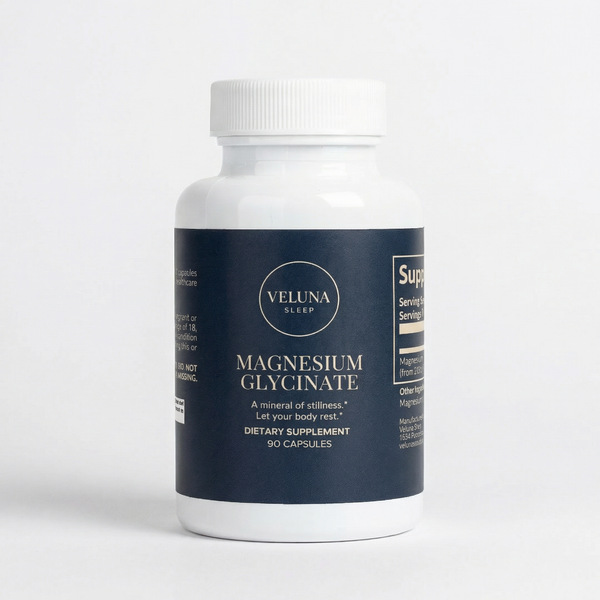
Veluna Magnesium Glycinate is a chelated glycinate with 275 mg of elemental magnesium per three-capsule serving, third-party tested. Magnesium supports normal muscle and nervous-system function. It is also sold in bundles, which you can compare on the magnesium for sleep page.
Common questions
Is magnesium glycinate or citrate better for sleep?
Neither has been shown to be better for sleep. Glycinate is the more common evening choice; citrate is more likely to loosen stools at higher amounts. See glycinate vs. citrate.
Is bisglycinate different from glycinate?
No, they are the same compound. See glycinate vs. bisglycinate.
When should I take it?
Follow the label. Many people take it in the evening. What matters more is taking it regularly.
References
- Mah J, Pitre T. Oral magnesium supplementation for insomnia in older adults: a systematic review & meta-analysis. BMC Complement Med Ther. 2021;21(1):125. PMID: 33865376
- Schuster J, Cycelskij I, Lopresti A, Hahn A. Magnesium bisglycinate supplementation in healthy adults reporting poor sleep: a randomized, placebo-controlled trial. Nat Sci Sleep. 2025;17:2027-2040. PMID: 40918053
- Pardo MR, Garicano Vilar E, San Mauro Martín I, Camina Martín MA. Bioavailability of magnesium food supplements: a systematic review. Nutrition. 2021;89:111294. PMID: 34111673
- National Institutes of Health, Office of Dietary Supplements. Magnesium: Fact Sheet for Health Professionals. ods.od.nih.gov
*These statements have not been evaluated by the Food and Drug Administration. This product is not intended to diagnose, treat, cure, or prevent any disease. This article is for informational purposes only and does not constitute medical advice. Talk to a healthcare professional before starting any supplement, especially if you are pregnant, nursing, taking medication, or have a medical condition.